SourceScore: check how authentic a page looks.
Paste a URL and SourceScore reads what is actually in the page's HTML. Four readouts, and every point comes with the check behind it.
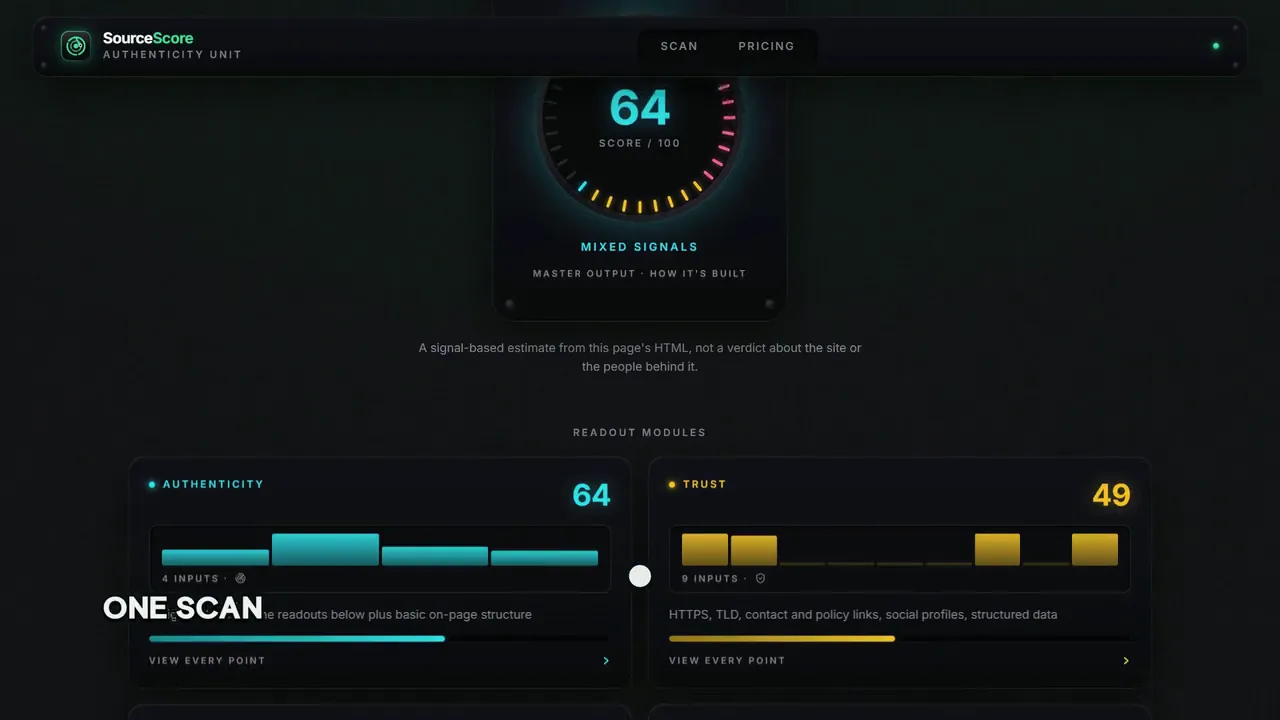
Before you quote a source, you want to know if it deserves it. Reading the page tells you some of that. The HTML tells you more.
SourceScore checks how authentic a page looks. You paste a URL. It fetches the page and checks what is actually in its HTML, then shows where every point came from.
How it works
- 01Paste a URL. SourceScore fetches the page.
- 02Read four scores. Authenticity, Trust, AI-Style Text and Fabrication Risk.
- 03Open the checks. Each score lists the checks behind it: HTTPS, contact and policy links, structured data, hype phrases and AI-style phrasing.
- 04Act on the fixes. Missing signals come with suggested fixes. Share the result link so others see the same checks.
Four readouts. Every point explained.
What the scores mean
Authenticity is a fixed blend of the other readouts plus basic on-page structure. Trust looks at HTTPS, TLD, contact and policy links, social profiles and structured data. Fabrication Risk looks for hype phrases, missing contact or privacy links and very thin content.
AI-Style Text looks for stock phrases and writing patterns common in generated text. It is an estimate, not proof. The same goes for every score here: they are estimates from on-page signals, not a verdict about a site or the people behind it.
Who it is for
Writers and researchers who want a quick look at a source before they quote or link it. Editors and reviewers who need everyone looking at the same checks. Site owners who want to see which trust signals their own pages are missing.
Free and paid
Free needs no sign-up and gives you 3 scans a day. You get every score with its checks explained, plus share links and suggested fixes. Every plan runs the same checks. Paid plans raise the daily limit and add scan history in your console.
Starter is $4 a month billed quarterly ($12), Pro $11 ($33) and Enterprise $39 ($117), launch prices. Monthly is $5, $14 and $49; yearly $42, $114 and $396. A one-time Pro is $49.
Starter is 25 scans a day, Pro 200 and Enterprise 1,000. Limits reset at 00:00 UTC. Plans and history use your QOL ID.